Managing trial finance shouldn’t slow the science.
Protocols change. Sites drop. Timelines slip. Every change eventually shows up on an invoice — today, usually as a spreadsheet war between Finance and Clinical Operations. Veritasa keeps both teams on the same running budget, line-by-line, across the full life of the trial.
Ingest
Built for how CROs actually send things: PDFs (native, scanned, OCR), XLSX, CSV. Budget files, workorders, change orders, invoices, credit memos, expense reports — auto-classified by document type on upload.
Line-item extraction preserves categories, sub-items, unit pricing, and the “per week / per visit / per patient” units CRO pricing actually uses. Every invoice line is linked back to its originating workorder or change order.
Authorization vs. actual charges
For every invoice, Veritasa shows the authorized amount (from the workorder or change order) side-by-side with the actual charge, line-by-line. Reasonableness checks and markup checks are surfaced automatically — no spreadsheet required.
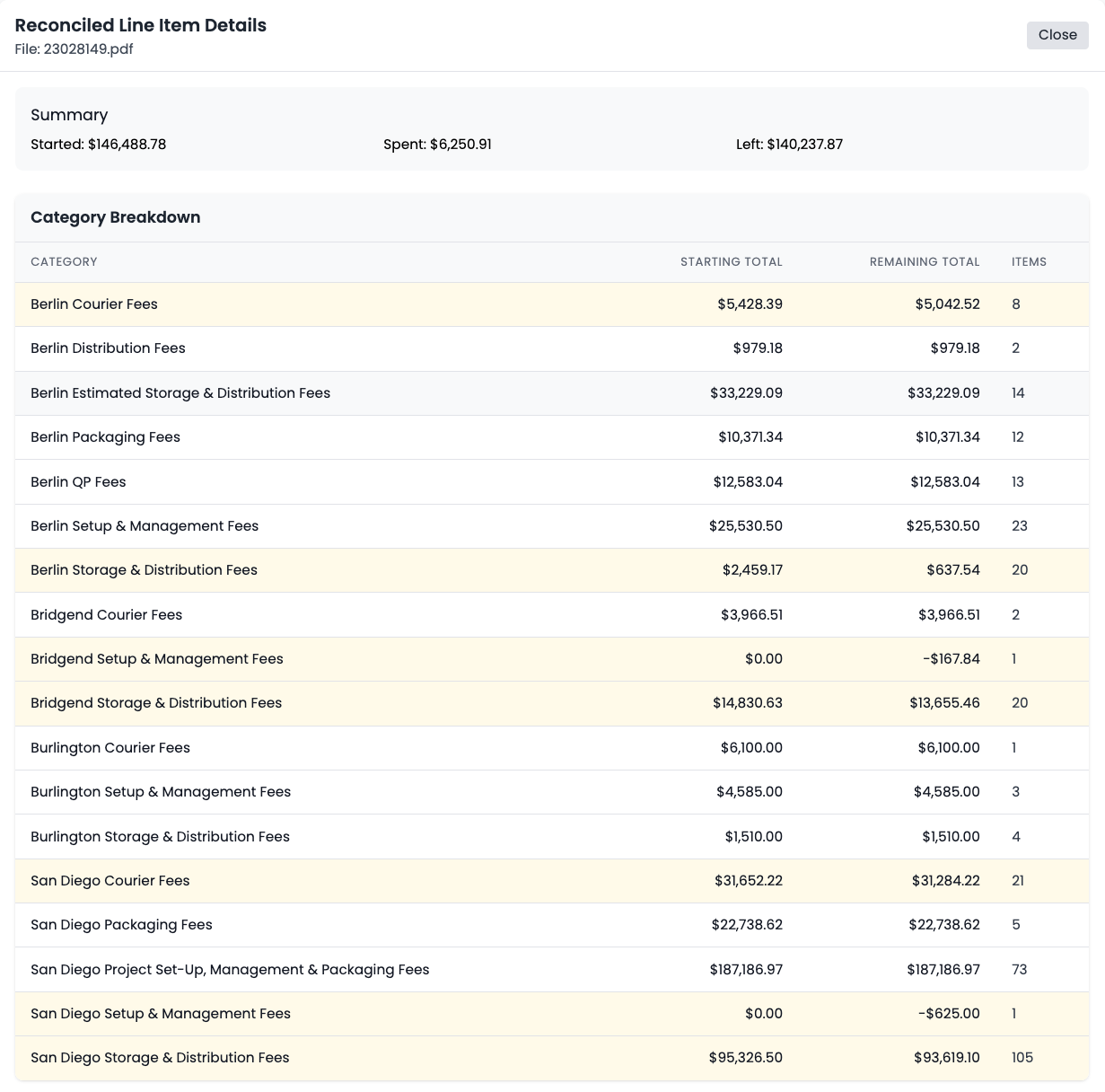
A running budget across the full life of the trial
Every document updates the project’s running budget. Workorders and change orders authorize spend; invoices consume it; credit memos roll it back. Finance and Clinical Operations always see the same single number for “what’s left” and “what’s spent” at any point in time.
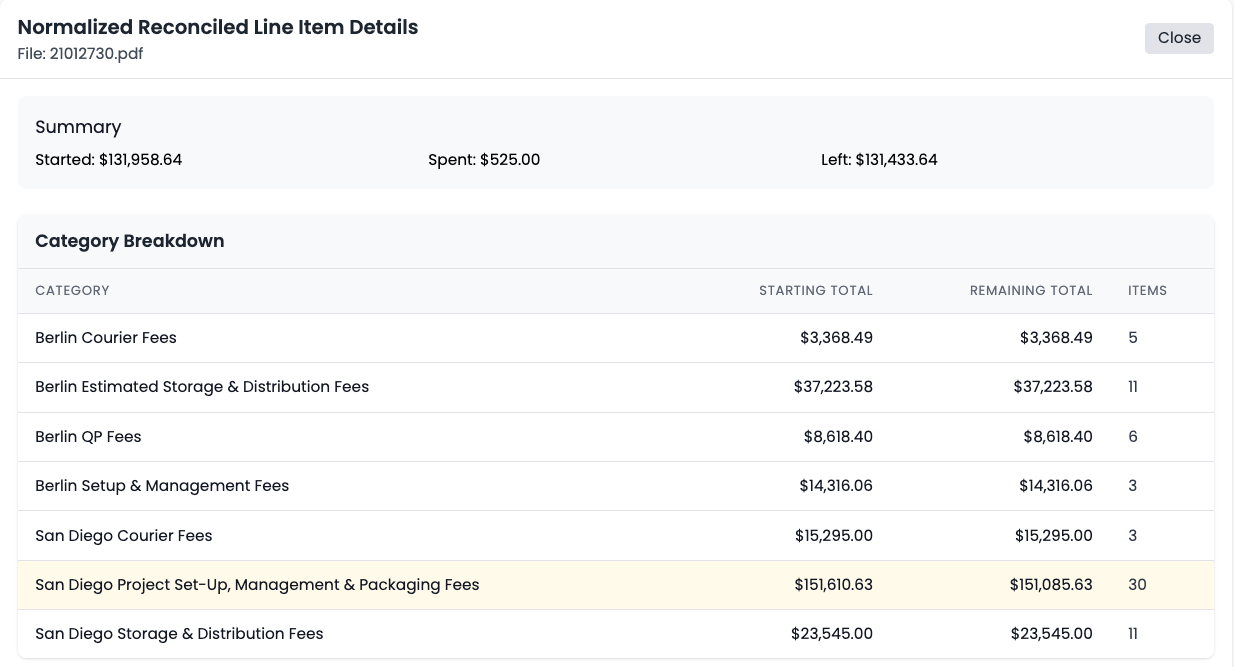
Variance, surprises, and unmatched items
Category-level variance. Line-item-level variance (e.g., “Central Lab is 38% over plan”). Unmatched items flagged automatically — most audit surprises live here.
When CROs rename, recategorize, or shuffle line items between invoices, the matching engine keeps the trail intact. Your audit story stays clean even when the vendor’s formatting doesn’t.
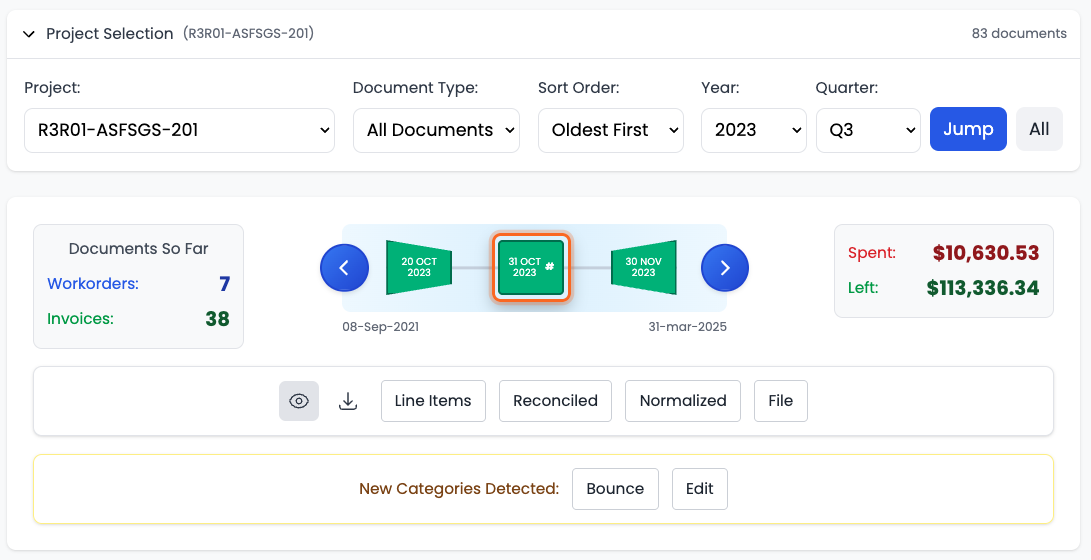
Clinical context, not just financial context
Veritasa knows which project each document belongs to, where in the trial timeline the work was authorized, and what protocol commitments the CRO is billing against. That context is visible to both Finance reviewers and Clinical Operations in the same view — the same running budget, the same reconciliation, the same answers.
Ask Vera — finance and clinical in one question
- “Which invoices in 2024 had Project Management Services exceed what was authorized?”
- “Total paid to the CRO by quarter vs. plan for project R2R01-CSA-AKI-201.”
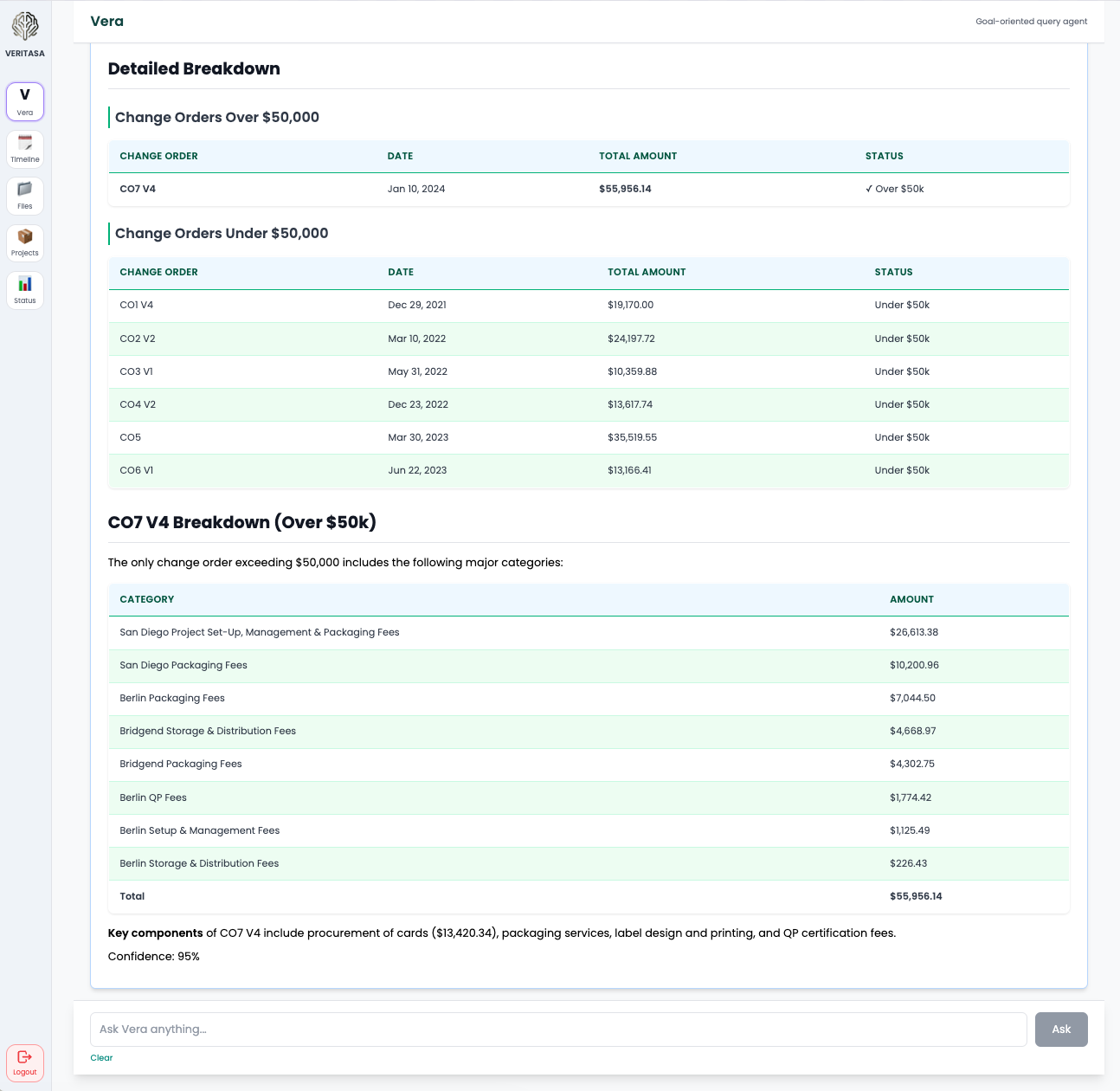
- “Every change order over $50k and the category it hit.”
- “Did freight charges in the May invoice match the change order?”
Cares about the trial’s outcomes and protocol. Knows what the CRO is supposed to be doing — but isn’t tracking whether the billing reflects it.
Can approve payment — but can’t easily tell whether the charges are appropriate for the study. Sees line items; doesn’t see the protocol.
Questions sponsors ask us.
How does Veritasa handle CROs that rename or reshuffle line items between invoices?
Our matching engine links each invoice line back to its originating workorder or change order even when the label, category, or ordering changes between invoices. Unmatched items are flagged rather than silently dropped, and you can confirm or correct matches in the reconciliation view. Your audit trail stays intact even when the vendor’s formatting doesn’t.
What document formats and CRO templates are supported?
PDF (native and scanned), XLSX, XLS, CSV. Budget files, workorders, change orders, invoices, credit memos, and expense reports across all major CRO templates we’ve seen in Phase II/III work. Documents are auto-classified on upload; unusual formats get reviewed during onboarding.
How is this different from a CTMS?
A CTMS tracks operational trial progress — sites, visits, subjects, milestones. Veritasa tracks the financial reality of the same trial — what was authorized, what was invoiced, where the two diverge, and what that means for your running budget. The two are complementary; many sponsors run both.
Do you integrate with our ERP or accounting system?
Today, REST API and MCP (for Claude Desktop-style agentic access) out of the box. CSV and XLSX exports for AP handoff. Direct ERP and accounting connectors (NetSuite, QuickBooks, SAP) are on the roadmap; let us know what you use and we’ll share where it lands on the list.
SOC 2, HIPAA, 21 CFR Part 11 — what’s your posture?
Veritasa is designed to the controls implied by those standards: encryption at rest and in transit, tenant isolation, immutable audit logs on every document operation, and role-based access control. Detailed posture on our Security page.
Who owns the data and the extractions?
You do. Both the original documents you upload and the structured extractions Veritasa produces from them. Export everything at any time in the same formats you put in, with no export fee and no proprietary-schema dependency. See No vendor lock-in.
How do you avoid vendor lock-in?
Your data exits in the same format it came in. REST API and MCP (Claude Desktop integration). ERP and accounting exports on the roadmap. Read the full position on independence →